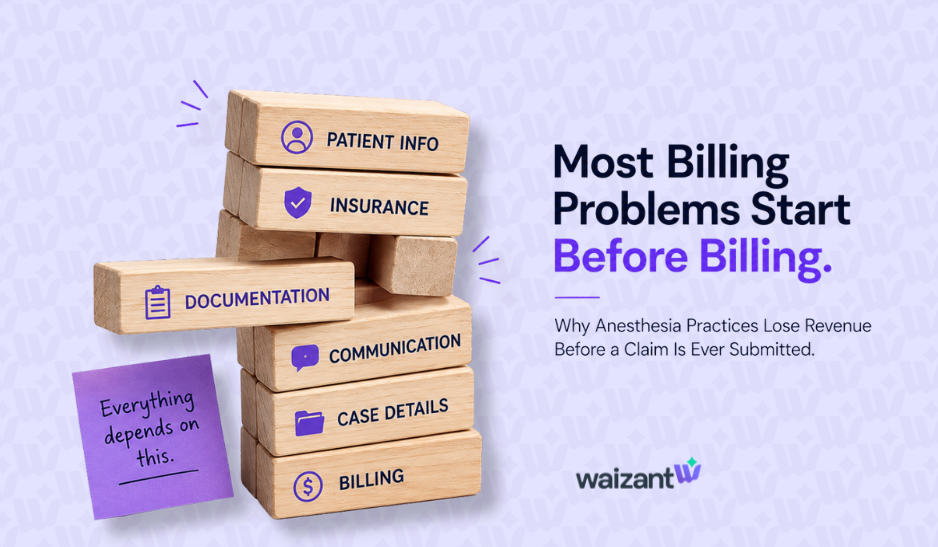
 Most Billing Problems Start Before Billing">
Discover why anesthesia practices lose revenue before a claim is ever submitted, and how improving documentation, communication, and workflows reduces denials and speeds reimbursement.
Why Anesthesia Practices Lose Revenue Before a Claim Is Ever Submitted
When healthcare organizations look for ways to improve financial performance, the conversation usually starts with billing. Teams focus on reducing denials, shortening days in accounts receivable, improving reimbursement rates, and increasing collections.
Those are all worthwhile goals, but they often overlook where the problem actually begins.
For many anesthesia practices, revenue isn’t lost because the billing team made a mistake. It’s lost because incomplete information, delayed documentation, or disconnected workflows created problems long before a claim was ever submitted.
By the time a case reaches billing, the damage has often already been done.
The goal isn’t simply to bill faster. It’s to prevent problems before they reach the billing team.
Revenue Leakage Starts Upstream
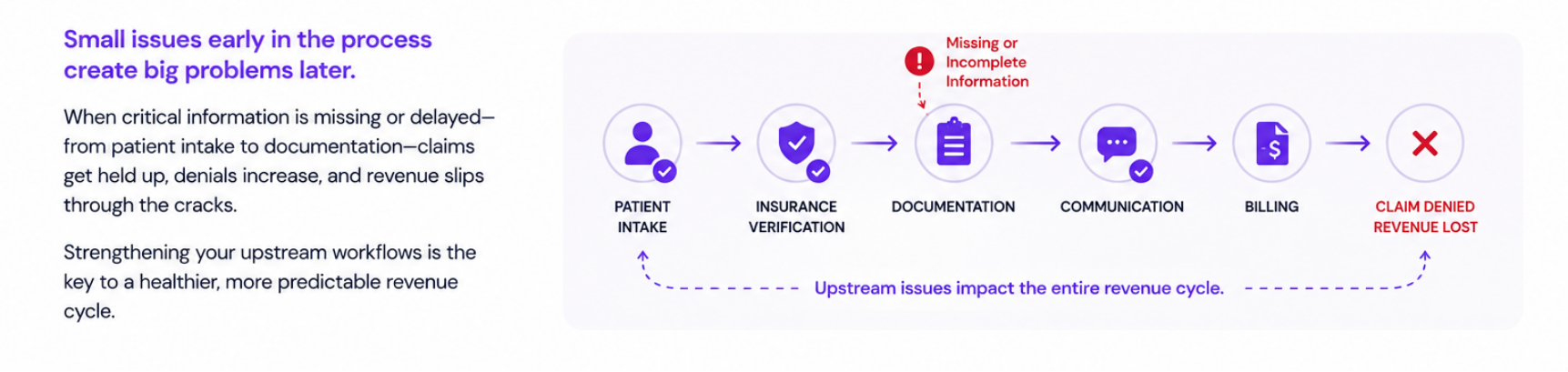
Every patient encounter generates information that ultimately determines whether a claim can be submitted accurately and on time. Patient demographics, insurance verification, provider documentation, procedure details, and communication between staff all contribute to a clean claim.
When any one of those pieces is missing, the billing process slows down.
An incomplete insurance ID can delay eligibility verification. A provider note that isn’t finalized can prevent coding. A communication breakdown between clinical staff and billing can leave a case sitting unresolved for days or even weeks.
These aren’t billing problems, they’re operational problems that eventually become billing problems.
Small Errors Create Expensive Consequences
Operational inefficiencies rarely appear dramatic in the moment. A missing authorization, an incomplete chart, or a delayed signature may only take a few minutes to correct individually.
Across hundreds or thousands of cases each month, however, those small interruptions become significant.
Healthcare organizations often experience:
- Delayed claim submission
- Preventable claim denials
- Increased administrative rework
- Slower reimbursement
- Reduced visibility into case status
While the financial impact is measurable, the operational impact is often even greater. Staff spend valuable time tracking down information, correcting errors, and communicating across disconnected systems instead of focusing on higher-value work.
Why Billing Teams Can’t Solve the Problem Alone
Billing departments are frequently expected to improve revenue cycle performance, yet many of the issues affecting reimbursement occur well before a biller ever sees the claim.
Patient registration teams collect demographic and insurance information. Providers complete clinical documentation. Practice administrators coordinate workflows. Communication occurs between multiple departments, facilities, and systems.
If those processes aren’t connected, billing teams inherit incomplete information and spend their time fixing problems instead of processing claims efficiently.
Improving reimbursement therefore requires more than better billing software. It requires better operational workflows.
The Cost of Disconnected Systems
Many anesthesia organizations rely on separate applications for scheduling, communication, documentation, reporting, and billing. While each system may perform its individual task well, the gaps between them often create unnecessary administrative work.
Every manual handoff introduces another opportunity for information to be delayed, duplicated, or overlooked. Staff are forced to re-enter data, search for documentation, send follow-up emails, or reconcile conflicting information between systems.
The result isn’t simply inefficiency; it creates operational friction that directly affects revenue.
Organizations that reduce these handoffs often see improvements not only in billing performance but also in staff productivity, compliance, and overall operational visibility.
Building a Stronger Foundation for Revenue Cycle Performance
Leading healthcare organizations are shifting their focus upstream.
Rather than concentrating exclusively on reducing denials after claims are submitted, they’re improving the quality of information entering the revenue cycle in the first place.
That includes creating more consistent documentation processes, capturing complete patient information, improving communication between departments, reducing manual data entry, and increasing visibility into operational workflows.
When accurate information follows the patient throughout the entire care journey, billing becomes faster, cleaner, and significantly more predictable.
How Connected Healthcare Platforms Help
Technology alone isn’t the answer. But connected technology can remove many of the operational barriers that create revenue leakage.
Healthcare operations platforms that centralize communication, documentation, billing, and reporting help teams work from a single source of truth rather than multiple disconnected applications.
Instead of asking staff to spend their day searching for information, connected workflows make information easier to capture, easier to find, and easier to act on.
That translates into fewer delays, fewer preventable errors, and greater confidence that every billable case is accurately documented before it reaches billing.
The Bottom Line
Most billing problems don’t start in billing.
They begin with the operational processes that occur long before a claim is generated: during patient registration, documentation, communication, and case management.
Healthcare organizations that improve these upstream workflows are often better positioned to reduce administrative burden, strengthen financial performance, and capture revenue that might otherwise be lost.
Cleaner data at the beginning creates better outcomes at the end.
See How Waizant Helps Reduce Revenue Leakage
Frequently Asked Questions
Why do anesthesia practices lose revenue before billing?
Revenue loss often begins before claims are submitted due to incomplete patient information, delayed documentation, disconnected systems, manual data entry, and communication breakdowns. These operational issues create delays and increase the likelihood of claim denials.
How can anesthesia practices reduce claim denials?
Practices can reduce preventable denials by improving documentation accuracy, capturing complete patient and insurance information, streamlining communication, and reducing manual workflows before billing begins.
What causes missed billable anesthesia cases?
Missed cases are commonly caused by incomplete documentation, fragmented workflows, delayed provider sign-offs, and limited visibility into case status rather than errors during claim submission.
Why is operational visibility important?
Operational visibility allows healthcare organizations to identify bottlenecks before they affect billing, helping teams resolve missing documentation, incomplete patient information, and workflow delays earlier in the process.
.png)