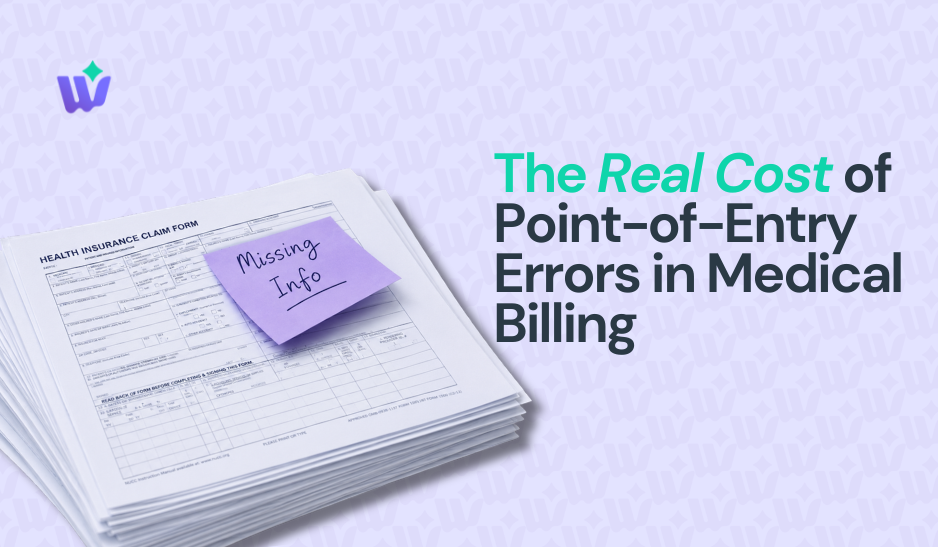
 The Real Cost of Point-of-Entry Errors in Medical Billing">
What do medical billing errors really cost? Explore the impact of point-of-entry mistakes on denials, cash flow, staff productivity, and revenue cycle performance.
Medical billing errors rarely start in billing.
They start earlier — at intake, during documentation, inside disconnected systems, or through rushed manual entry.
A missing insurance ID.
An incorrect date of birth.
An incomplete provider note.
A modifier left off a procedure.
Small mistakes at the point of entry create downstream operational problems that quietly impact reimbursement, staff productivity, compliance, and cash flow.
Most organizations measure denials.
Very few measure the operational cost of fixing preventable errors.
That’s where the real loss happens.
What Is a Point-of-Entry Error?
A point-of-entry error is any inaccurate, incomplete, or delayed information entered at the beginning of the patient or billing process.
Common examples include:
- Missing insurance information
- Incorrect patient demographics
- Eligibility not verified
- Incomplete provider documentation
- Coding inconsistencies
- Delayed charge entry
- Duplicate or manual re-entry tasks
These errors often appear small in isolation.
Operationally, they compound quickly.
The Hidden Cost of Rework
Most healthcare organizations can identify denied claims.
Fewer can quantify:
- staff time spent correcting errors
- delayed reimbursement cycles
- communication back-and-forth
- duplicate documentation
- resubmission labor
- operational slowdowns
A single claim correction may only take 10–15 minutes.
But across hundreds or thousands of claims per month, those small interruptions become an operational drag.
For example:
If a billing team spends:
- 12 minutes fixing an average claim issue
- across 400 preventable errors monthly
That equals: 80+ hours of rework every month.
That’s two full work weeks spent correcting avoidable issues.
And that time rarely appears on operational reports.
Delays Impact More Than Revenue
Point-of-entry errors create ripple effects across the organization.
Operationally, they can lead to:
- delayed reimbursements
- increased AR days
- higher denial rates
- audit exposure
- provider frustration
- reduced staff efficiency
- slower patient communication
Over time, teams become reactive instead of operationally proactive.
The issue is no longer billing.
It becomes organizational friction.
Why These Errors Keep Happening
Most healthcare organizations still operate across:
- disconnected systems
- manual intake processes
- fragmented communication tools
- paper-based workflows
- delayed documentation cycles
The result:
Teams spend more time fixing information than trusting it.
And when information moves across multiple platforms, every handoff increases the chance of error.
The Operational Shift Healthcare Teams Need
Improving billing performance is not just about faster claims processing.
It starts with cleaner operational infrastructure upstream.
Organizations reducing billing friction successfully are focusing on:
- real-time data capture
- centralized communication
- standardized documentation
- automated validation
- operational visibility across teams
The goal is simple: Reduce correction work before it starts.
What Better Point-of-Entry Systems Look Like
Modern healthcare operations platforms help reduce rework by improving how information is captured, validated, and shared from the start.
That includes:
- digital intake tools
- real-time eligibility verification
- centralized documentation
- secure communication
- automated billing support
- operational dashboards
When teams work from cleaner data, billing becomes faster because operations become more accurate.
That distinction matters.
How Waizant™ Helps Reduce Billing Friction
Waizant™ is a self-service, cloud-based healthcare operations platform designed to simplify communication, documentation, billing support, and operational visibility.
Instead of relying on disconnected systems and manual correction cycles, Waizant™ helps organizations:
- capture cleaner information at the source
- reduce administrative rework
- improve documentation accuracy
- centralize operational communication
- streamline billing-related processes
- improve visibility across teams
The result is fewer preventable delays and stronger operational control.
The Bigger Operational Cost
The real cost of billing errors is not just denied revenue.
It’s:
- lost staff time
- operational inefficiency
- delayed decisions
- fragmented communication
- preventable administrative work
Most organizations do not have a billing problem.
They have a data accuracy problem upstream.
And that changes how healthcare operations should be optimized moving forward.
What a Billing Error Actually Costs You (And It’s Not Just Money)
I’ve seen healthcare teams spend hours every week correcting information that should have been accurate the first time.
Not because people were careless.
Because the systems around them made accuracy harder than it needed to be.
One missing modifier becomes:
- a denied claim
- a follow-up email
- a corrected submission
- another review cycle
- another delay
Multiply that across dozens of claims per day, and operational slowdowns become normal.
The difficult part is that most of this labor never shows up in reporting.
You’ll see denial numbers.
You won’t always see:
- interruption costs
- staff context switching
- delayed communication
- duplicated work
- manual follow-up time
Those hidden operational costs add up quickly.
That’s why improving healthcare operations is no longer just about moving faster.
It’s about reducing friction before it spreads across the organization.
See how Waizant™ helps healthcare teams automate workflows, improve claim accuracy, and create cleaner revenue operations.
.png)