 Why General Healthcare Analytics Falls Short for Anesthesia RCM">
Healthcare Analytics is a well-known concept, but for anesthesia billing companies and RCM leaders, generic platforms often create more noise than clarity. Traditional healthcare data tools are built for broad hospital metrics or general specialty billing; they are not designed for the highly specific, time sensitive nature of anesthesia.
In the anesthesia revenue cycle, clinical and operational data (including case volume, unit trends, and charge capture) are unique. The challenge for RCM firms isn't a lack of information; it is that traditional reporting shows what already happened, long after the opportunity to intervene has passed.
The Gap Between General Analytics and Anesthesia Specifics
Standard healthcare analytics practices often fail to account for the fragmented workflows unique to anesthesia. Scheduling, documentation, and billing follow separate timelines, leading to several critical issues for the billing office:
- Fragmented Views: Leaders review partial data, creating unnecessary friction between clinical sites and the billing team.
- Reconciliation Waste: Teams spend valuable hours manually reconciling inconsistent numbers instead of improving collections.
- Delayed Action: Reporting becomes a post-mortem review rather than a tool for daily operational support.
Upstream Integrity: Protecting the Revenue Cycle at the Source
For RCM organizations, the biggest bottleneck is receiving "dirty" data from the facility. True anesthesia analytics change this dynamic by building insights at the point of care. This ensures documentation is clean and validated before it ever reaches the billing office. By focusing on upstream integrity, RCM firms can move away from constant data cleanup and toward a more automated, predictable workflow.
Strategic Anesthesia Analytics: Moving Toward Zero Touch Billing
In an era of rising labor costs, RCM owners are looking for ways to reduce the number of "touches" required on a claim. Analytics designed for this environment help leaders identify the specific providers or facilities causing documentation gaps.
By pinpointing these patterns, RCM firms can implement targeted training that moves the practice toward a zero-touch billing environment. This allows for labor light scalability, where a billing company can grow its client base without a proportional increase in administrative headcount.
1. Improving OR Utilization and Throughput
Operational performance is determined case by case. Analytics designed for anesthesia help RCM firms prove their value to their clients by identifying where capacity is underutilized. By evaluating room utilization, turnover intervals, and first case reliability, you provide the "Ready to Action" insights that hospital administrators crave.
2. Strengthening Multi-Site Consistency
For growing RCM firms, multi-site variation is a major risk. Specific analytics make cross site comparison practical, allowing leaders to evaluate throughput patterns and documentation trends using consistent definitions. This consistency is a competitive advantage for forecasting and maintaining stable staffing levels across a diverse client portfolio.
3. Protecting Revenue Integrity
Revenue performance depends on precise documentation, including modifiers, start/stop times, and qualifying circumstances. Unlike general tools, anesthesia specific analytics pinpoint exactly where errors repeat. This strengthens charge capture and reduces the downstream rework that slows down the entire billing cycle.
Why RCM Leaders Choose WaizantTM
An analytics platform only works if it aligns with how your organization actually runs. When evaluating a solution at events like the HBMA Innovation Conference, look for a platform that answers:
Which specific documentation gaps are directly impacting your clean claim rate?
What denial patterns are emerging by payer, facility, or individual provider?
How can you provide executive level visibility to your clients without manual Excel wrangling?
WaizantTM is built specifically for RCM and operational leaders who need clear performance insights without adding clinical complexity.
FAQs
1. How does WaizantTM help RCM companies specifically?
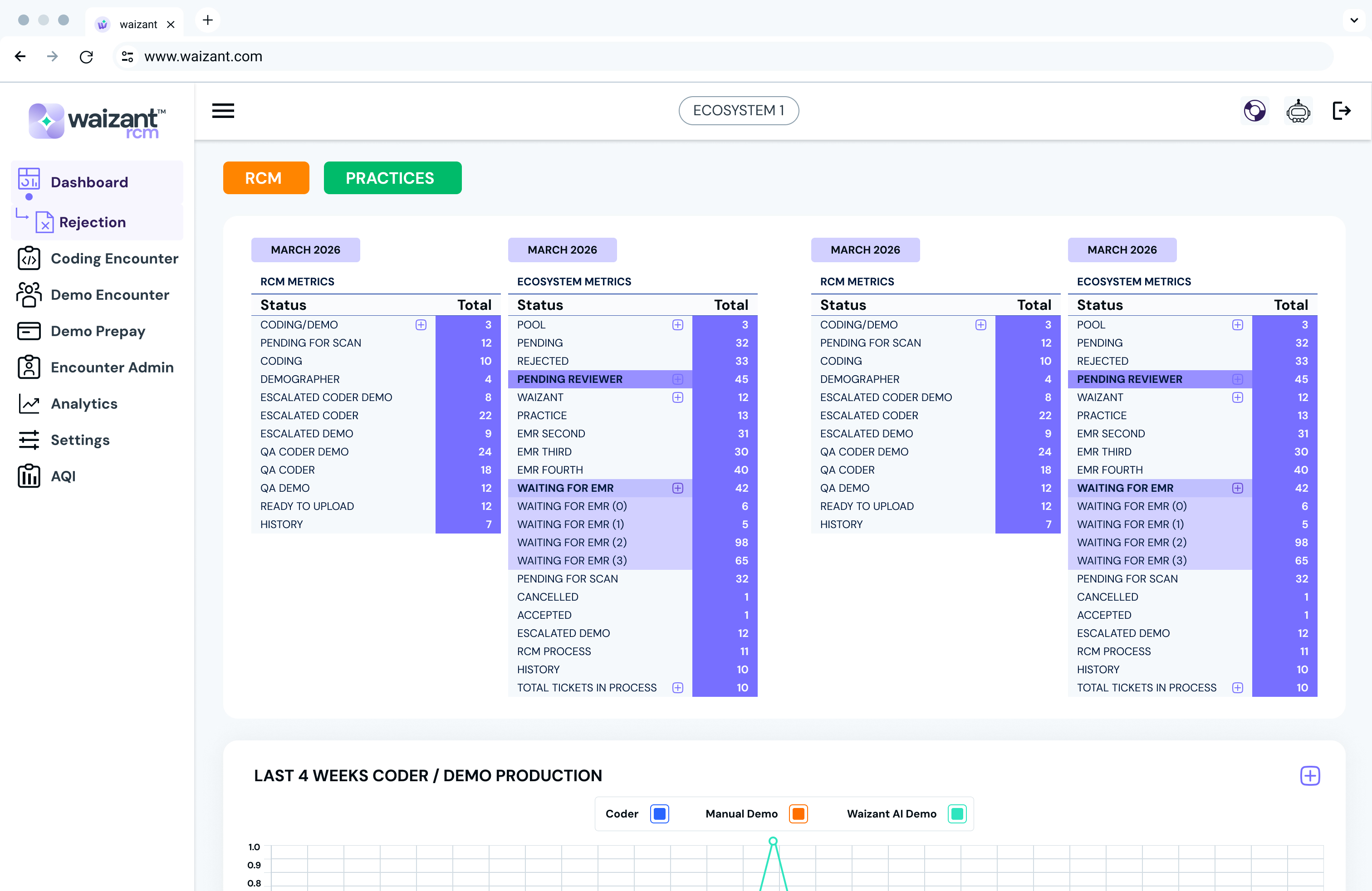
WaizantTM acts as a bridge between the clinical site and the RCM team. By providing real-time anesthesia analytics, we help RCM companies identify missing charges instantly, reduce manual data entry errors, and provide their clients with high-level executive dashboards that prove their value.
2. What is the difference between General Healthcare Analytics and Anesthesia Analytics?
While general healthcare analytics tracks broad hospital trends, anesthesia analytics focuses on specific data trails such as reliable time logic, unit trends, concurrency, and anesthesia modifiers required for both operational efficiency and revenue integrity.
3. How can analytics move an RCM firm toward Zero Touch Billing?
By identifying recurring documentation gaps and payer specific denial trends upstream, analytics allow RCM firms to fix workflows at the point of care. This reduces the manual "touches" required to process a claim and improves days in AR.
4. Can anesthesia analytics help with labor efficiency in the billing office?
Yes. By automating the reconciliation process and providing clear insights into where revenue is being left on the table, analytics allow RCM firms to scale their operations without significantly increasing their administrative headcount.
.png)