Choosing new healthcare technology? Learn the five questions every healthcare leader should ask before investing in a new platform to improve operations and reduce administrative burden.
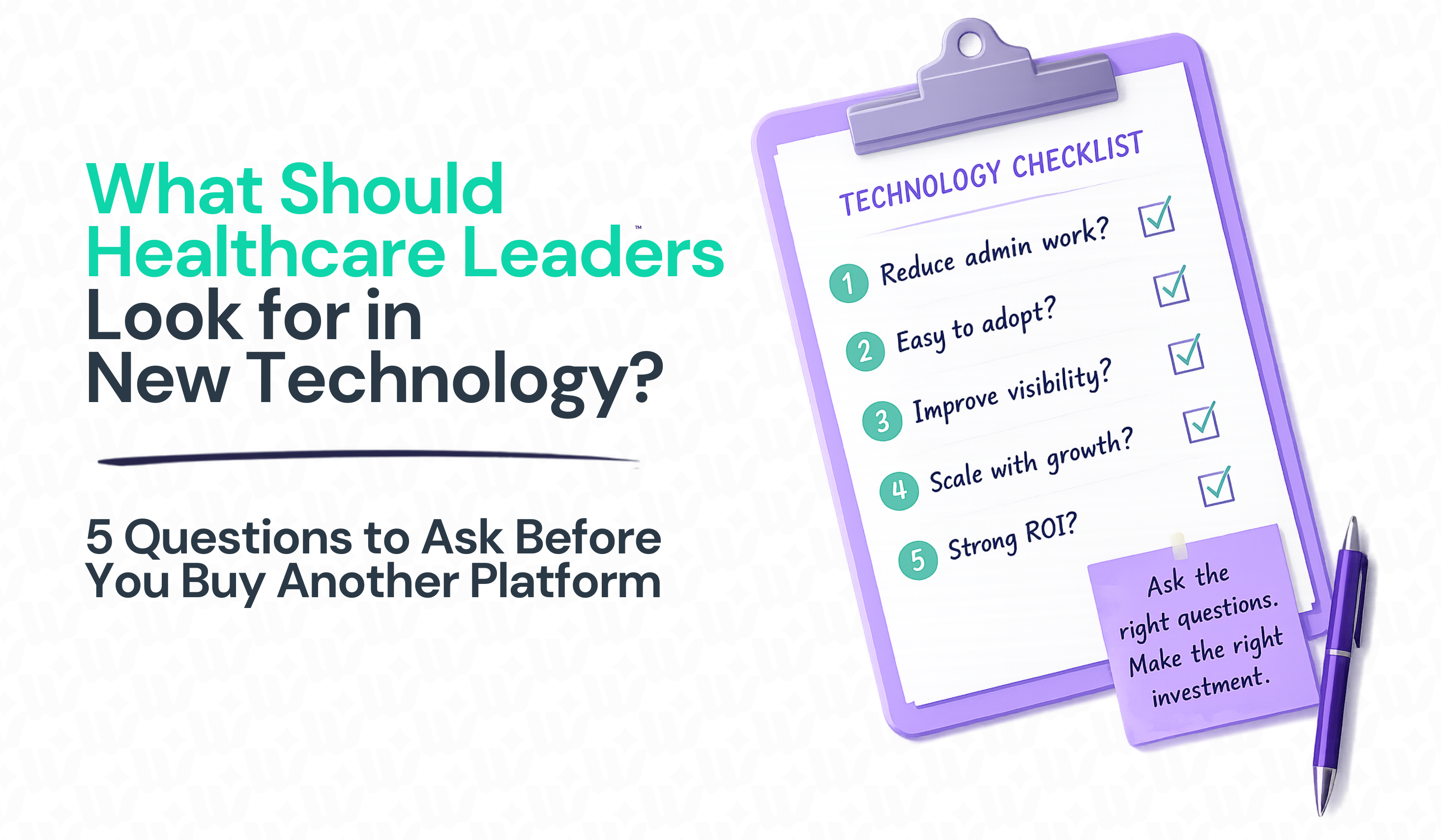
What Should Healthcare Leaders Look for in New Technology?
5 Questions to Ask Before You Buy Another Platform
Every healthcare technology vendor promises the same thing: better efficiency, improved communication, streamlined operations, and a stronger return on investment.
The challenge isn't finding software with a compelling demo. It's finding technology that actually makes life easier for your team after implementation.
With healthcare organizations under constant pressure to improve outcomes, control costs, and reduce administrative burden, every technology investment matters. Before adding another platform to your tech stack, here are five questions every healthcare leader should ask.
1. Will It Reduce Administrative Work or Add More?
Technology should remove manual tasks, not create new ones.
If your team has to enter the same information multiple times, switch between multiple applications, or spend hours reconciling data, the software is creating work instead of eliminating it.
The best solutions simplify everyday tasks so clinicians and staff can spend more time focused on patient care, not paperwork.
2. Will It Fit Into How Your Team Already Works?
Successful technology supports existing clinical and operational processes.
If adoption requires major workarounds, excessive training, or constant switching between applications, it's unlikely to become part of your team's daily routine.
Look for solutions that naturally fit into how information is captured, shared, and used throughout the day.
3. Will It Improve Visibility Across Your Organization?
Healthcare leaders make better decisions when they have access to timely, accurate information.
Whether it's documentation, billing, compliance, or operational reporting, leaders should be able to quickly understand what's happening without chasing down updates from multiple systems.
Better visibility leads to faster decisions and fewer surprises.
4. Will Your Team Actually Use It?
The most powerful technology is the technology people actually adopt.
Simple interfaces, intuitive navigation, mobile accessibility, and fewer clicks all contribute to higher adoption rates.
If the software makes daily tasks easier, your team won't need to be convinced to use it.
5. Will It Grow With Your Organization?
Healthcare is constantly evolving.
Choose technology that can support new locations, growing teams, changing regulations, and future operational needs without requiring another major software purchase a year from now.
The right platform should solve today's challenges while supporting tomorrow's growth.
Technology Should Simplify Healthcare, Not Complicate It
Healthcare organizations don't need more software.
They need technology that reduces administrative burden, improves visibility, and helps teams work more efficiently.
When evaluating your next technology investment, don't just ask what new features it offers. Ask whether it will genuinely make life easier for the people who use it every day.
How Waizant Helps
Waizant is designed to simplify healthcare operations by bringing secure communication, documentation, charge capture, and operational visibility together in one connected platform. Instead of adding another application for your team to manage, Waizant helps reduce administrative work while supporting the daily activities that keep healthcare moving.
Frequently Asked Questions
What should healthcare leaders consider before purchasing new technology?
Look beyond feature lists. Consider whether the platform reduces administrative work, improves visibility, supports adoption, fits into daily operations, and can scale with your organization.
Why do healthcare technology implementations fail?
Many implementations struggle because they introduce additional complexity, require significant process changes, or fail to gain user adoption.
How can healthcare organizations reduce administrative burden?
Reducing duplicate documentation, simplifying communication, eliminating manual data entry, and improving operational visibility can significantly reduce administrative work.
What makes healthcare software successful?
The most successful platforms are easy to use, fit naturally into existing processes, improve visibility, and help teams accomplish everyday tasks more efficiently.
Why is user adoption important?
Even the most advanced technology won't deliver value if clinicians and staff don't use it consistently. Ease of use is often one of the strongest predictors of long-term success.
Ready to Simplify Healthcare Operations?
Communication is just one piece of a connected healthcare operation.
See how Waizant™ brings communication, documentation, billing, and operational visibility together in one secure, self-service platform.
Continue Reading
If you enjoyed this article, you may also like:
.png)