 Why Healthcare Software Shouldn’t Create More Work">
Healthcare software should simplify operations—not create more work. Learn how connected workflows reduce administrative burden and improve efficiency.
The Best Technology Simplifies Operations, It Doesn’t Add More Steps
Healthcare technology is supposed to make work easier.
It’s meant to improve efficiency, reduce administrative burden, and give clinicians and administrators more time to focus on patient care. Yet for many healthcare organizations, the opposite has happened.
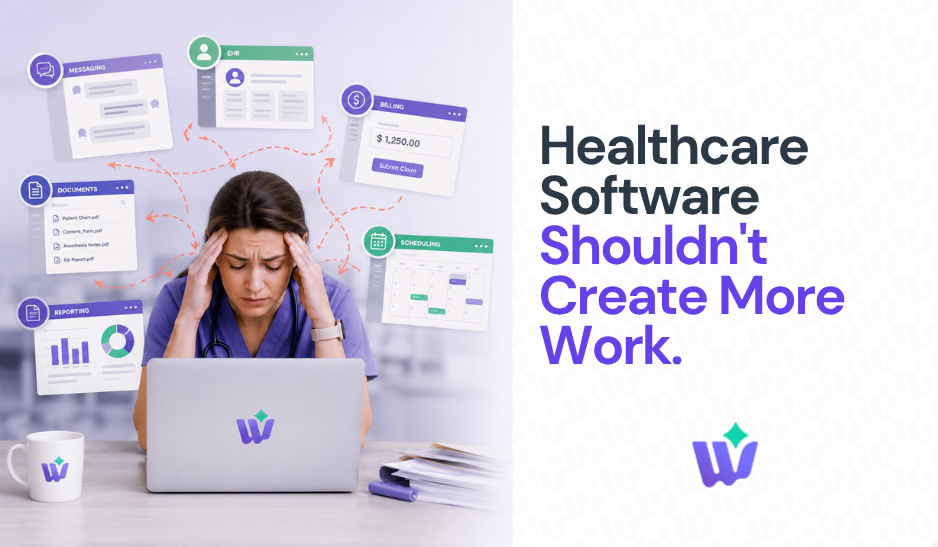
Over the last decade, healthcare teams have adopted new platforms for scheduling, documentation, communication, billing, reporting, compliance, and analytics. While each system may solve a specific problem, together they’ve created a new one: fragmented operations.
Instead of simplifying workflows, many organizations now spend their day switching between applications, re-entering information, and searching for data spread across multiple systems.
When technology creates more work instead of removing it, productivity suffers, and so does the healthcare experience for staff and patients alike.
Healthcare technology should reduce administrative burden—not become part of it.
When More Software Creates More Complexity
Healthcare organizations rarely choose disconnected systems intentionally. Most platforms are implemented to solve an immediate operational need, whether that’s documentation, secure messaging, billing, scheduling, or reporting.
Over time, however, those individual solutions begin to operate independently rather than as part of a connected workflow.
The result is a patchwork of applications that requires staff to constantly move between systems just to complete routine tasks. Information must be entered multiple times, documents are stored in different locations, and communication happens across email, text messages, EHR messaging, and phone calls.
In many organizations, these disconnected workflows eventually affect reimbursement and financial performance. We explored this in Most Billing Problems Start Before Billing, where we explain how operational issues often become billing problems long before a claim is submitted.
The problem isn’t that healthcare organizations have technology. It’s that too much of it doesn’t work together.
Administrative Burden Isn’t Just a Staffing Problem
Healthcare leaders often associate administrative burden with staffing shortages or increased regulatory requirements. While those factors certainly contribute, disconnected technology can have an equally significant impact.
When teams spend valuable time searching for information, correcting duplicate records, or manually transferring data between systems, those hours add up quickly.
Common examples include:
- Re-entering patient information into multiple applications
- Searching for documentation across different platforms
- Waiting for updates from another department
- Reconciling conflicting information between systems
- Generating reports manually instead of automatically
Each additional task may only take a few minutes, but multiplied across hundreds of patients and dozens of employees, the operational cost becomes substantial.
Many healthcare organizations are also exploring how artificial intelligence can reduce repetitive administrative work. As discussed in Everyone Is Talking About AI. Here’s What Healthcare Organizations Are Actually Using It For, AI is proving most valuable when it supports everyday operational workflows rather than replacing clinical decision-making.
Every extra login, manual handoff, and duplicate entry steals time from patient care.
Every Extra Step Introduces Risk
Efficiency isn’t the only concern.
Every manual handoff increases the likelihood of errors, delays, and missed information.
A document uploaded to one system but not another. A provider update shared by text instead of through a secure platform. A billing team waiting for documentation that’s stored somewhere else.
These small breakdowns don’t stay isolated. They affect communication, compliance, reimbursement, reporting, and ultimately the organization’s ability to operate efficiently.
The more systems employees must manage, the more opportunities there are for information to fall through the cracks.
Those communication and documentation gaps often surface later as denied claims or delayed reimbursement. Our article The Real Reason Your Claims Are Getting Denied explores several of the operational issues that contribute to preventable claim denials.
Every additional system creates another opportunity for information to fall through the cracks.
Connected Workflows Create Better Outcomes
The most effective healthcare organizations aren’t necessarily using fewer digital tools, they’re using technology that works together.
Connected workflows allow information to move seamlessly between communication, documentation, billing, reporting, and operational management. Staff spend less time searching for information because everyone is working from the same source of truth.
Instead of asking employees to adapt to disconnected software, connected platforms support the way healthcare teams actually work.
The goal isn’t simply digital transformation. It’s operational simplicity.
Organizations that connect these workflows are often better positioned to reduce many of the operational bottlenecks that slow the revenue cycle. If you’re evaluating where inefficiencies exist today, The Top 5 RCM Bottlenecks (and How to Fix Them Fast) is a helpful place to start.
The best healthcare software disappears into the workflow; it doesn’t interrupt it.
Technology Should Work for Your Team, Not the Other Way Around
When evaluating healthcare technology, it’s important to ask a different question.
Instead of asking whether a platform adds another feature, ask whether it removes another task.
Does it reduce duplicate work?
Does it improve visibility?
Does it simplify communication?
Does it eliminate manual processes?
Technology delivers the greatest value when it quietly removes friction from everyday operations rather than adding another login, another workflow, or another place to search for information.
The Future of Healthcare Operations Is Simplicity
Healthcare organizations are under constant pressure to improve efficiency while maintaining high-quality patient care.
The answer isn’t always adding another application. Often, it’s reducing complexity by connecting the workflows that already exist.
When communication, documentation, billing, and operational visibility work together, organizations spend less time managing technology and more time delivering care.
The best healthcare software doesn’t create more work.
It removes it.
Technology should support your team. Not require your team to support the technology.
How Waizant Helps Simplify Healthcare Operations
Reducing administrative burden isn’t about adding another piece of software—it’s about connecting the workflows your team already depends on.
Waizant is a self-service, cloud-based healthcare operations platform that brings communication, documentation, billing, and operational visibility together in one place. Instead of asking staff to switch between multiple applications, Waizant helps healthcare organizations streamline everyday processes, reduce manual work, and improve visibility across the entire operation.
Whether it’s securely communicating between teams, capturing cleaner billing data, managing documents, or monitoring operational performance, connected workflows help reduce friction so healthcare professionals can spend less time managing technology and more time delivering care.
Healthcare software shouldn’t create more work. It should quietly remove it.
Continue Reading
If you enjoyed this article, you may also like:
- Most Billing Problems Start Before Billing
- The Real Reason Your Claims Are Getting Denied
- Everyone Is Talking About AI. Here’s What Healthcare Organizations Are Actually Using It For
- The Top 5 RCM Bottlenecks (and How to Fix Them Fast)
Frequently Asked Questions
Why do healthcare organizations use so many different software systems?
Many healthcare organizations adopt specialized software over time to solve individual operational challenges such as scheduling, billing, documentation, messaging, or reporting. Without integration, these systems can create fragmented workflows that increase administrative burden.
How do disconnected healthcare systems affect productivity?
Disconnected systems often require staff to switch between multiple applications, manually re-enter data, search for information, and reconcile duplicate records. These inefficiencies reduce productivity and increase operational costs.
What is the administrative burden in healthcare?
Administrative burden refers to the non-clinical work required to manage healthcare operations, including documentation, reporting, communication, billing, compliance, and manual data entry. Inefficient technology can significantly increase this workload.
How can healthcare organizations reduce administrative burden?
Organizations can reduce administrative burden by streamlining workflows, improving communication, minimizing duplicate data entry, and using connected technology that centralizes operational processes.
What should healthcare leaders look for when evaluating software?
Healthcare leaders should prioritize solutions that simplify workflows, improve operational visibility, reduce manual work, integrate with existing processes, and make it easier for teams to communicate and access information.
Can connected healthcare platforms improve billing?
Yes. When communication, documentation, and operational workflows are connected, billing teams receive more complete and accurate information. This can reduce delays, administrative rework, and preventable claim issues.
.png)