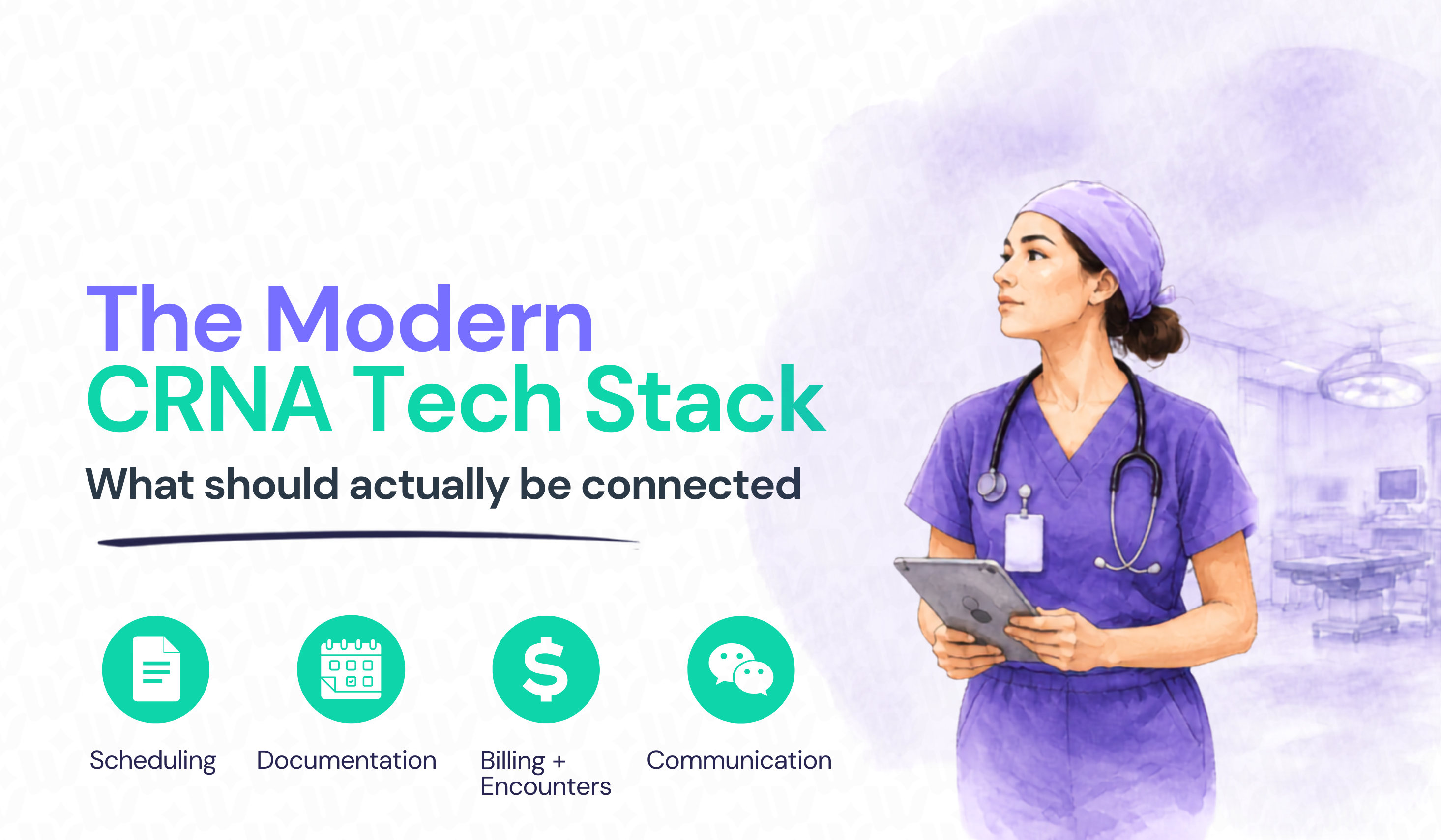
 The Modern CRNA's Tech Stack: What Should Actually Be Connected?">
Communication, documentation, billing, cloud storage, and charge capture shouldn't run on five different logins. See what a truly connected CRNA tech stack looks like.
Conference season has a way of making every CRNA look at their workflow with fresh eyes. Between sessions, you're swapping notes with colleagues about staffing platforms, documentation shortcuts, and the billing headaches nobody fully solves. It's the one week a year when "what software are you using?" is as common a question as "where are you working now?"
So here's a useful exercise for the ride home: pull up your phone and count how many separate logins it takes to get through a single case, start to finish. For a lot of CRNAs, the answer is uncomfortably high: a messaging app for scheduling and coverage, an EHR for documentation, a billing portal that's disconnected from both, a cloud drive for credentialing files and case notes, and a charge capture process that still involves a sticky note, a spreadsheet, or a memory that's had a very long day.
None of these tools are the problem on their own. The problem is that they don't talk to each other.
The real cost of a disconnected stack
When your tools operate in isolation, the gaps between them become your job. You become the integration layer, manually re-entering the same case details into three different systems, cross-checking a text thread against a schedule that hasn't updated, or chasing down whether a charge actually made it into the billing queue after a hectic OR day.
That's not a minor inconvenience. It's where revenue quietly leaks, where documentation lags behind the actual care delivered, and where burnout creeps in, not from the clinical work itself, but from the administrative tax layered on top of it.
What "connected" should actually mean
A modern CRNA tech stack isn't about having the most tools. It's about having the fewest handoffs. Five areas matter most, and they matter more together than any one of them does alone:
Communication: Scheduling changes, coverage requests, and case updates should live in the same place your team already checks, not scattered across texts, calls, and a separate app nobody remembers to open.
Documentation: Case notes and clinical documentation should be captured once, accurately, and in a format that's usable downstream, not re-typed into a second system for billing or compliance purposes.
Billing: If documentation and billing aren't connected, every case creates a translation problem. Charges should flow directly from the clinical record, not from someone's memory of what happened three patients ago.
Cloud storage: Credentialing documents, case history, and compliance records need to be accessible and current, without becoming their own filing project. Storage that's disconnected from your workflow becomes storage nobody trusts.
Charge capture: This is where the other four either pay off or don't. When communication, documentation, billing, and storage are actually linked, charge capture stops being a manual reconciliation task and starts being a natural byproduct of the work you already did.
Why this matters more during conference season
Every year, conference week surfaces a wave of new point solutions: a slicker scheduling app here, a better documentation shortcut there. Individually, they can look like real upgrades. But a new standalone tool that doesn't connect to the rest of your stack just adds a sixth login to the five you already have.
The better question to bring into any vendor conversation this week isn't "does this do X well?" It's "does this talk to everything else I use?"A tool that's excellent in isolation but isolated in practice still leaves you doing the integration work by hand.
How Waizant™ solves this
This is the gap Waizant™ was built to close. Instead of stitching together separate tools for communication, documentation, billing, storage, and charge capture, Waizant™ connects them as one workflow:
Communication and scheduling live in one place. Coverage requests, schedule changes, and case updates run through the same system your team already works in, so nothing gets missed in a side text thread.
Documentation feeds everything downstream. A case documented once flows directly into billing and reporting, with no re-entry and no second version of the same information to keep in sync.
Billing runs off the actual clinical record. Because documentation and billing share the same data, charges reflect what actually happened in the case, not a reconstruction from memory at the end of a long shift.
Cloud storage stays current on its own. Credentialing files, case history, and compliance records update as part of the normal workflow, rather than requiring a separate filing task.
Charge capture becomes automatic, not manual. With the other four connected, charges are generated as a byproduct of documenting the case, closing the gap where revenue typically leaks.
The goal isn't more software. It's fewer seams.If this week has you rethinking your stack, that's the question worth carrying home: not what should I add, but what should finally be connected
Want to see how it works? Schedule an introductory call and see how Waizant™ fits into your practice.
Frequently Asked Questions
What is a "connected" tech stack for a CRNA?
It means the tools you use for communication, documentation, billing, cloud storage, and charge capture share data automatically, so information entered once doesn't need to be re-entered into a second or third system.
Why does a disconnected tech stack cost CRNAs money?
When documentation and billing aren't linked, charges depend on someone manually remembering and re-entering them after the fact. That gap is where revenue most often gets missed, delayed, or lost entirely.
Isn't a specialized, standalone tool better than an all-in-one platform?
A standalone tool can be excellent at its one job and still create work if it doesn't talk to everything else you use. The question worth asking isn't how good a tool is in isolation, but whether it connects to your documentation, billing, and charge capture without manual handoffs.
How is Waizant™ different from using separate best-in-class apps for each function?
Waizant™ is built so communication, documentation, billing, cloud storage, and charge capture run on shared data from the start, rather than requiring integrations, exports, or manual re-entry to connect tools that were built separately.
Does switching to a connected platform mean changing how I document cases?
Not fundamentally. The goal is to capture documentation once, in the normal course of care, and let it flow through to billing and charge capture automatically, rather than changing your clinical workflow itself.
Is Waizant™ only for CRNAs, or does it work across other specialties too?
Waizant™ is used across a range of healthcare specialties. The communication, documentation, billing, and charge capture challenges described here are especially visible for CRNAs, but the same connected approach applies broadly.
Ready to Simplify Healthcare Operations?
See how Waizant™ brings communication, documentation, billing, and operational visibility together in one secure, self-service platform.
Continue Reading
If you enjoyed this article, you may also like:
Healthcare Operations
Healthcare Technology
Administrative Burden
Healthcare Communication
Cloud Storage
Document Management
CRNA
.png)