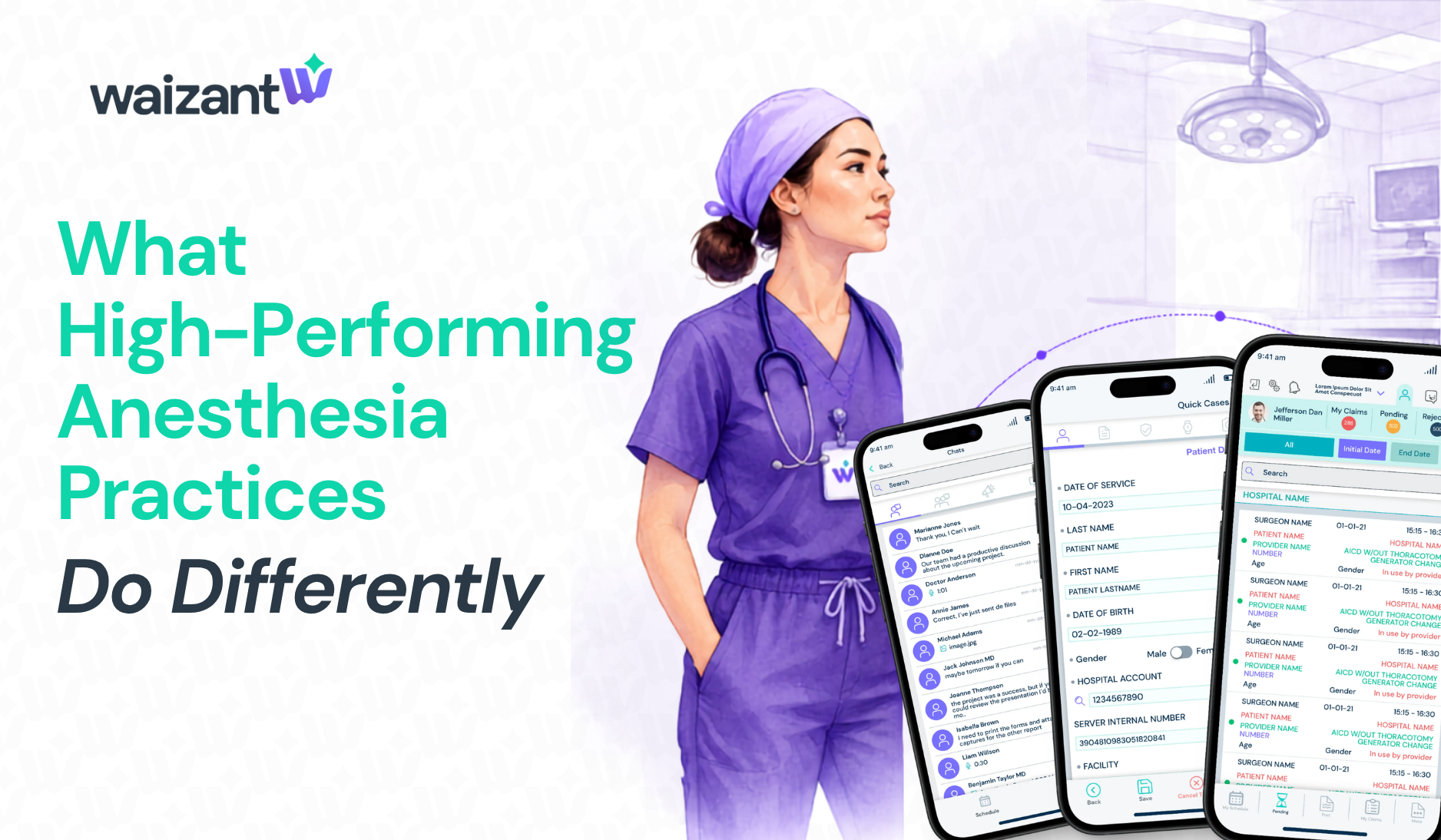
 What High-Performing Anesthesia Practices Do Differently">
Operational visibility, deliberate technology adoption, and data-driven staffing set high-performing anesthesia practices apart. See what they do differently.
Every anesthesia practice is dealing with the same pressures right now: tighter margins, staffing that's harder to plan around, and payers that don't make reimbursement any easier. So why do some practices seem to run smoothly while others are constantly putting out fires?
It's rarely a staffing difference, and it's almost never a talent difference. The CRNAs and anesthesiologists delivering care look remarkably similar from practice to practice. What separates the practices that scale well from the ones that stay stuck is operational, not clinical. It comes down to how the business behind the care is actually run.
It's rarely a staffing difference, and it's almost never a talent difference. The CRNAs and anesthesiologists delivering care look remarkably similar from practice to practice. What separates the practices that scale well from the ones that stay stuck is operational, not clinical. It comes down to how the business behind the care is actually run.
They know what's happening before it becomes a problem
In a lot of practices, leadership finds out about a scheduling gap, a documentation backlog, or a billing delay after it's already cost time or money. High-performing practices operate with real visibility instead: a clear, current picture of coverage, case status, and revenue cycle health, without needing to chase down five people or reconcile three spreadsheets to get it.
That visibility isn't a reporting luxury. It's what lets administrators catch a staffing gap two weeks out instead of two hours out, and what lets a practice owner see a billing bottleneck while it's still small enough to fix quickly.
That visibility isn't a reporting luxury. It's what lets administrators catch a staffing gap two weeks out instead of two hours out, and what lets a practice owner see a billing bottleneck while it's still small enough to fix quickly.
They treat administrative time as a real cost
It's easy to think of documentation delays, manual charge entry, and scheduling back-and-forth as background noise, the normal friction of running a practice. High-performing practices treat that friction as a line item. Every hour a provider or administrator spends reconciling systems that don't talk to each other is an hour not spent on coverage, growth, or patient care.
This shows up most clearly in how these practices evaluate new tools and processes. The question isn't "does this look modern?" It's "does this reduce the number of steps between an event happening and it being visible, documented, and billed?"
This shows up most clearly in how these practices evaluate new tools and processes. The question isn't "does this look modern?" It's "does this reduce the number of steps between an event happening and it being visible, documented, and billed?"
They adopt technology deliberately, not reactively
A lot of practices accumulate software the way people accumulate kitchen gadgets: one purchase at a time, each solving a problem in the moment, with no one checking whether it fits together with what's already there. High-performing practices approach technology adoption differently. They ask how a new tool affects the full operational picture, not just the one task it's meant to fix.
That deliberateness pays off in ways that are easy to underestimate. Fewer systems means fewer places for information to get lost. Fewer logins means less time spent on administrative overhead and more time spent on the parts of the practice that actually grow revenue.
That deliberateness pays off in ways that are easy to underestimate. Fewer systems means fewer places for information to get lost. Fewer logins means less time spent on administrative overhead and more time spent on the parts of the practice that actually grow revenue.
They make data-driven staffing and coverage decisions
Coverage planning is one of the clearest places where operational maturity shows. Reactive practices staff around whoever's available and hope it holds. High-performing practices staff around patterns, case volume trends, provider availability, historical utilization, and use that data to plan coverage ahead of time rather than scrambling to fill it after the fact.
This isn't about having more data than everyone else. It's about having data that's trustworthy and current enough to actually act on, which circles back to the same operational foundation: clean documentation, accurate billing, and systems that stay in sync.
This isn't about having more data than everyone else. It's about having data that's trustworthy and current enough to actually act on, which circles back to the same operational foundation: clean documentation, accurate billing, and systems that stay in sync.
Operational excellence is a system, not a checklist
None of this comes down to a single fix. Visibility, cost discipline, deliberate technology adoption, and data-driven staffing all depend on the same underlying thing: a practice's core systems working together instead of in isolation. A practice can hire well, staff well, and still lose ground if the operational layer underneath it is fragmented.
That's the shift worth making. Not asking which individual tool to add next, but asking whether the systems already in place are actually giving leadership what they need to run the practice with confidence.
That's the shift worth making. Not asking which individual tool to add next, but asking whether the systems already in place are actually giving leadership what they need to run the practice with confidence.
How Waizant™ solves this
Waizant™ was built around the same principle these practices already operate on: the systems behind the care need to work as one, not as five disconnected tools an administrator has to hold together manually.
Real-time visibility, not after-the-fact reporting. Coverage, case status, and revenue cycle health live in one place, so leadership sees a gap while it's still small, not after it's already cost time or money.
Administrative time gets reclaimed, not just tracked. By connecting communication, documentation, billing, and charge capture, Waizant™ removes the manual reconciliation work that quietly eats provider and administrator hours every week.
One system instead of an accumulated stack. Rather than adding another point solution, Waizant™ replaces the patchwork with a single connected platform, so new functionality doesn't come at the cost of more logins or more places for information to get lost.
**Staffing decisions backed by current data.** Because documentation and case data flow through the same system in real time, practice leadership can plan coverage around actual patterns and trends instead of reacting to gaps as they appear.
The result isn't just a cleaner tech stack. It's the operational visibility and control that high-performing practices already rely on, built in from the start rather than assembled after the fact.
Real-time visibility, not after-the-fact reporting. Coverage, case status, and revenue cycle health live in one place, so leadership sees a gap while it's still small, not after it's already cost time or money.
Administrative time gets reclaimed, not just tracked. By connecting communication, documentation, billing, and charge capture, Waizant™ removes the manual reconciliation work that quietly eats provider and administrator hours every week.
One system instead of an accumulated stack. Rather than adding another point solution, Waizant™ replaces the patchwork with a single connected platform, so new functionality doesn't come at the cost of more logins or more places for information to get lost.
**Staffing decisions backed by current data.** Because documentation and case data flow through the same system in real time, practice leadership can plan coverage around actual patterns and trends instead of reacting to gaps as they appear.
The result isn't just a cleaner tech stack. It's the operational visibility and control that high-performing practices already rely on, built in from the start rather than assembled after the fact.
The result isn't just a cleaner tech stack. It's the operational visibility and control that high-performing practices already rely on, built in from the start rather than assembled after the fact.
Want to see how it works? Schedule an introductory call and see how Waizant™ fits into your practice.
Frequently Asked Questions
What makes an anesthesia practice "high-performing" from an operations standpoint?
It means the tools you use for communication, documentation, billing, cloud storage, and charge capture share data automatically, so information entered once doesn't need to be re-entered into a second or third system.
Why does administrative inefficiency matter as much as clinical performance?
Every hour spent reconciling disconnected systems, chasing documentation, or manually entering charges is an hour not spent on coverage or growth. Over a year, that time adds up to a real, measurable cost, even though it rarely shows up as its own line item.
How can a practice get better visibility into coverage and billing without hiring more administrative staff?
The gap is usually not a staffing gap, it's a systems gap. Connecting documentation, billing, and scheduling into one platform gives leadership the same visibility that adding headcount is often used to solve for.
What's the difference between adding more software and improving operations?
Adding software solves one problem in isolation and often creates a new one: another login, another system that doesn't talk to the rest. Improving operations means evaluating whether a new tool strengthens the whole system, not just the task in front of you.
How does Waizant™ support data-driven staffing decisions?
Waizant™ keeps documentation, case data, and scheduling connected in real time, so practice leadership can staff around actual case volume and utilization patterns instead of reacting to coverage gaps after they appear.
Is this approach only relevant for large anesthesia groups, or does it apply to smaller practices too?
Operational fragmentation affects practices of every size. Smaller practices often feel it more acutely, since there's less staff capacity to absorb the manual work that disconnected systems create.
Every hour spent reconciling disconnected systems, chasing documentation, or manually entering charges is an hour not spent on coverage or growth. Over a year, that time adds up to a real, measurable cost, even though it rarely shows up as its own line item.
How can a practice get better visibility into coverage and billing without hiring more administrative staff?
The gap is usually not a staffing gap, it's a systems gap. Connecting documentation, billing, and scheduling into one platform gives leadership the same visibility that adding headcount is often used to solve for.
What's the difference between adding more software and improving operations?
Adding software solves one problem in isolation and often creates a new one: another login, another system that doesn't talk to the rest. Improving operations means evaluating whether a new tool strengthens the whole system, not just the task in front of you.
How does Waizant™ support data-driven staffing decisions?
Waizant™ keeps documentation, case data, and scheduling connected in real time, so practice leadership can staff around actual case volume and utilization patterns instead of reacting to coverage gaps after they appear.
Is this approach only relevant for large anesthesia groups, or does it apply to smaller practices too?
Operational fragmentation affects practices of every size. Smaller practices often feel it more acutely, since there's less staff capacity to absorb the manual work that disconnected systems create.
Ready to Simplify Healthcare Operations?
See how Waizant™ brings communication, documentation, billing, and operational visibility together in one secure, self-service platform.
Continue Reading
If you enjoyed this article, you may also like:
Healthcare Operations
Healthcare Technology
Administrative Burden
Healthcare Communication
Cloud Storage
Document Management
CRNA
.png)